
Korea House carries nearly 40 years of Korean family tradition into Tucson’s evolving food scene
For nearly four decades, Korea House, the oldest Korean restaurant in Arizona, has been a place where Tucson diners can experience Korean cuisine, culture and family traditions all under one roof.
Opened in 1985, the restaurant is now in the hands of its third-generation owner, Albert Baker, who is continuing the legacy started nearly 40 years ago.
“It was my great-uncle that opened it,” Baker said. “Then my parents took over in 2004-2005ish, and I started taking over in 2022.”
For Baker, Korea House has always been more than just a restaurant. It is a connection to his family’s history and a way to share Korean culture with the Tucson community.
A Family Legacy Preserved
Though Baker was the only one of his immediate brothers born in the United States, his family’s roots in the Old Pueblo run deep. After his grandmother immigrated to Tucson, his great-aunt and uncle followed, founding Korea House at a time when Tucsonans knew very little about Korean cuisine.
“In 1985, Korean food wasn’t what it is now to Americans,” Baker reflected. “People didn’t really know too much. Luckily, we had Davis-Monthan Air Force Base, and a lot of people who had been stationed in Korea became our customers,” he said.
His father, James, used the restaurant as a vessel for a grander mission: introducing Korean culture to Southern Arizona. James started and ran Korean language schools in town and served as a pastor for local Korean churches.
“For him, running a restaurant wasn’t just for profit,” Baker said. “He ran it to be able to show Korean cuisine. That made him happy, to finally be able to show a little bit more of our culture and our history.”
When the hardships of COVID-19 pushed his parents to consider selling the restaurant, Albert, who had left for a time to venture off and work at other local eateries, knew he had to come back.
“They’ve always wanted me to take over because they want to keep the family tradition going,” Baker said. “So that way, we can keep it in the family.”
Balancing Tradition with Innovation
When Baker took over, he immediately launched a comprehensive three-month remodel to liven up the space, bringing a sleek, modern touch to the historic restaurant while honoring its heritage. But Baker isn’t stopping there.
“We’re tweaking things and trying to make it a little bit better for the customer experience,” he said, teasing an upcoming revamp of the private rooms into immersive themed spaces, including a K-pop room and a Korean history room.
The physical space isn’t the only thing evolving. He is heavily focused on expanding the beverage program, particularly when it comes to Korean alcohol, which has historically been difficult to source in Tucson.
“Growing up in Tucson, I didn’t go anywhere that had Korean alcohol. There was very basic stuff—a couple of sojus here, a couple of beers,” he explains. “I wanted to bring it forward, so I searched for all the ones I could get down here.”
The restaurant’s bar features custom, Korean-forward drinks, with Baker planning to expand the cocktail program with new creations inspired by traditional Korean flavors.
Authentic Flavors, Made by Family
Despite the modern updates, the menu remains fiercely dedicated to time-tested family recipes. “My aunt and my mom are the ones that cook in the back, so everything is made like family,” Baker said.
That connection shines through in signature dishes like their jjamppong — a rich, fiery seafood noodle soup loaded with vegetables and toasted peppers. It’s a dish Baker has loved since childhood, long before his parents owned the joint.
“Before my parents owned it, I would always ask to come here to get jjamppong,” he reminisced. “It wasn’t something my mom or grandma cooked at home because it’s a pain to make. Our soups use a house bone broth that cooks for 48 hours minimum, so everything is really rich and deep.”
Beyond the comforting bowls of soup, the kitchen shines in its execution of iconic, sharable main courses. Take their samgyeopsal (pork belly), for instance. While many diners recognize pork belly as simply grilled meat, Korea House prepares theirs jeyuk bokkeum style. This means the pork belly is stir-fried with onions, green onions, and an array of vegetables. The result is a second depth of flavor, balancing the natural richness of the pork belly with a kick of spice, a hint of smoky char, and a subtle sweetness extracted from the onions.
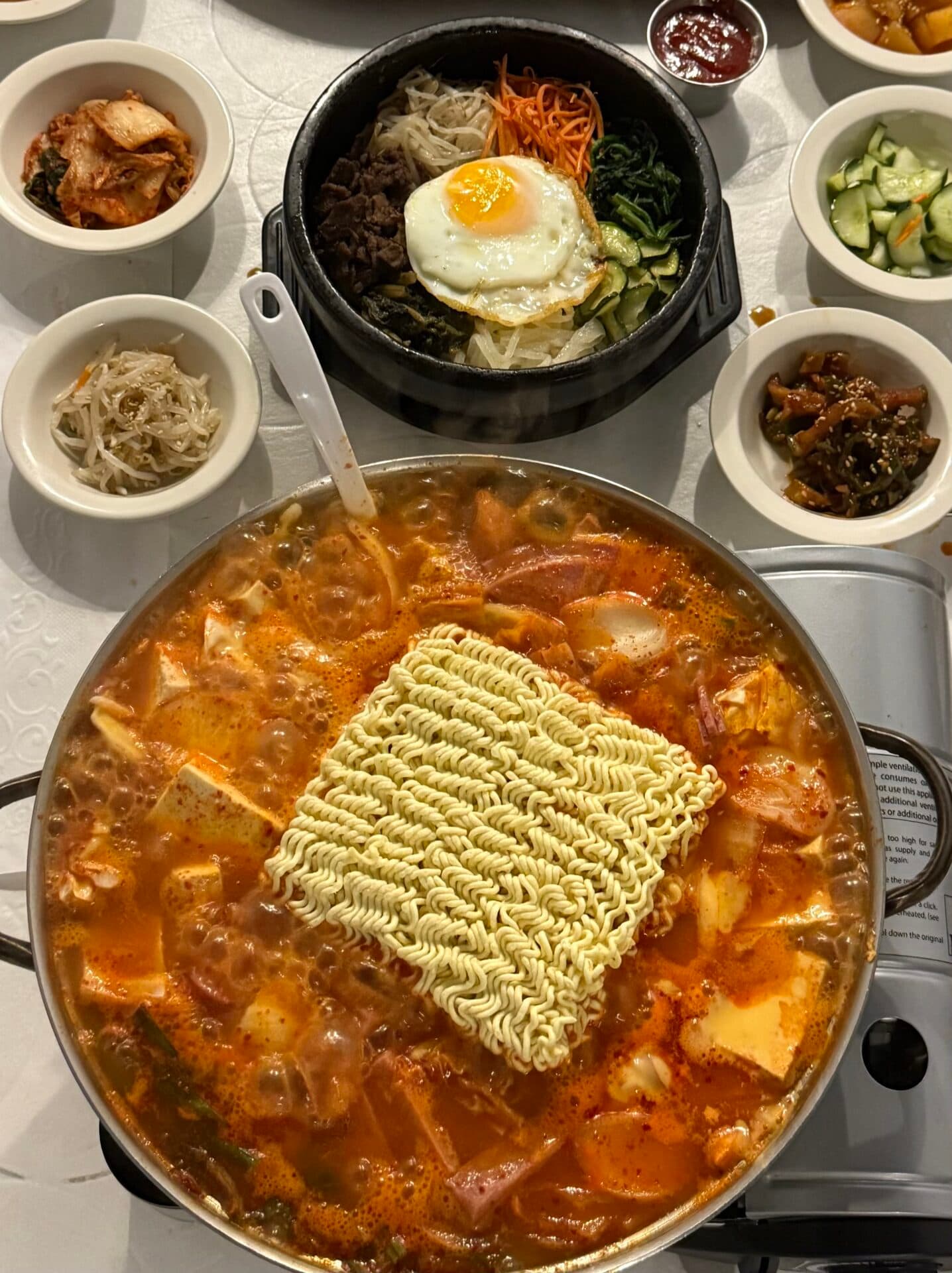
Another standout is their budae-jjigae, or “army stew.” This comforting, spicy Korean fusion hot pot is a culinary crossroads in a bowl, loaded with savory ingredients like Spam, all-beef hot dogs, baloney, kimchi, tofu, assorted vegetables, and noodles, all perfectly topped with melted cheese.
While the kitchen sources authentic ingredients like premium gochujang (chili paste) and red pepper flakes directly from Korean distributors to maintain absolute consistency, they also know how to accommodate the local palate. Over the decades, they’ve adapted their oi muchim (cucumber salad) to be a refreshing, side dish, and they keep the heat on their house-made kimchi at an approachable medium-low.
“When people used to ask for ‘hot,’ we’d make it Korean hot, and dishes were getting sent back because it was too spicy!” Baker said. “Now, we do a little less mild than what you’d get in traditional Korea. We can always add spice, but we can’t take it away.”
A Home Away From Home
Today, Korea House draws a diverse crowd, from international college students to generational regulars. Albert notes that global pop culture has fueled a massive surge in curiosity.
“We’ve seen an increase in things that BTS has mentioned in interviews, or things people see in K-dramas,” he said. “For a while, we saw a huge push for gimbap and tteokbokki.”
Meanwhile, local Korean families flock to the restaurant for comfort foods that are labor-intensive to prep at home, like jajangmyeon (black bean noodles), galbi (marinated short ribs), and yukgaejang (spicy shredded beef soup).
In the coming months, guests can look forward to even more traditional classics hitting the menu, including tteok mandu guk (rice cake and dumpling soup) and bibim guksu (a cold, vibrant mixed noodle dish tossed with fresh vegetables).
For Baker, every menu addition, playlist update, and modern cocktail tweak serves a singular, heartfelt goal: hospitality.
“We always want to make it a homey feeling,” Albert says. “I just want to be able to make people feel like they’re family. Make sure everybody feels welcome here.”
Korea House is located in Tucson, Arizona. Keep an eye out for their upcoming menu additions and newly themed dining rooms over the next few couple of months.
Article written by: