
Apacheria Cukson is not your typical pop-up taco stand.
For one thing, it sits on a quiet residential street rather than in a faceless parking lot. For another, it has an unusual name, one that invites inquiry.
But it’s the recipes of Gabriel Padilla that really make Apacheria Cukson stand out. Every bite of his food has a backstory – of his far flung family origins, of the Tucson culinary community, and especially, of the area’s native heritage. Padilla said, “We have all these unique native ingredients here, and I want to bring the knowledge of modern culinaria to use them.”

What’s In a Name?
The “Apacheria” in the taco stand’s name refers to the vast American Southwest and northern Mexican region where several Apache tribal confederations ranged until the Apache Wars of the mid-1880s. After Chief Geronimo surrendered to the U.S. Army in 1886, most Apache were imprisoned and/or exiled from the region, but a small contingent hid out in the Sierra Madres. Among them was Padilla’s great grandfather who, in the 1930s, moved to Tucson – the city originally called Cuk Șon, “at the base of the dark hill” in the O’odham language.
The Anglo and Spanish Connections
The ancestors of Elizabeth Beck, Padilla’s maternal grandmother, came over from England on the William & Mary around 1624. Beck grew up in Miami and left behind her husband – “a minor league baseball player of some Anglo and Cherokee mix,” as Padilla described him– when she moved to Tucson with three children. Among them was one-year-old Kathe, Padilla’s mother.
The Padilla family line originated in Andalucia, Spain; missionary Juan de Padilla arrived in what is now Texas in the 1520s. By the time Padilla’s father, Richard, was born in Tucson, however, he didn’t speak any Spanish. He was taught the language by Mario and Stella Cota-Robles, two Tucson lawyers who adopted him at the age of nine and raised him in Barrio Santa Rosa.
The Evolution of a Cuisine
His adoptive parents also taught Richard to cook. “My dad makes phenomenal green corn tamales,” Padilla said. Gabriel and his siblings were also expected to learn. “As soon as we could look over the table, my mom had us cooking,” Padilla said, referring to his two older brothers and older sister. “We grew up making tamales [like my father’s], and from my mother's side, picking up different dishes, including a taco salad that has French dressing in it.”

Another influence was Tucson’s UNESCO Creative City of Gastronomy designation in 2015. Padilla had an “overwhelming feeling that I need to be part of that,” he said, referring to the recognition the award gave to the city’s rich culinary heritage.
And so he began experimenting.
For example, Padilla said, “It took me years to develop a squash tamale.” He tried butternut squash and winter squash before coming up with the idea of using the less dense calabacita squash. “I cook the masa like grits,” he explained. “And one of the lovely things of using calabacitas is you end up with the juice on the bottom of the pan, and that juice gives the masa flavor.”
He also experimented with cholla buds, tepary beans, and especially nopal, prickly pear pads. “I tried cooking, pan frying, grilling, roasting, until I found the right type of nopal and the methods to cook it so it's not slimy.” He incorporated these ingredients into his salsas and a wide range of dishes, lending them distinctive flavor and texture.

Creating a Food Business
Padilla came to see that he had a unique concept for a food truck or a restaurant. “My idea was to bring the unification of the Anglo, the Hispanic, and the native food cultures to Tucson,” he explained. “Because of my background, I knew nobody's going to come up with my idea.”
Which is fortunate. It took Padilla some eight years to bring any version of his concept to fruition. During that time, he worked the front and back of the house of various restaurants, and in grocery stores, “just about every department up to management.” Then a friend got him a job at a catering company. He thought, “This is the last thing that I have to learn before I do it myself.”

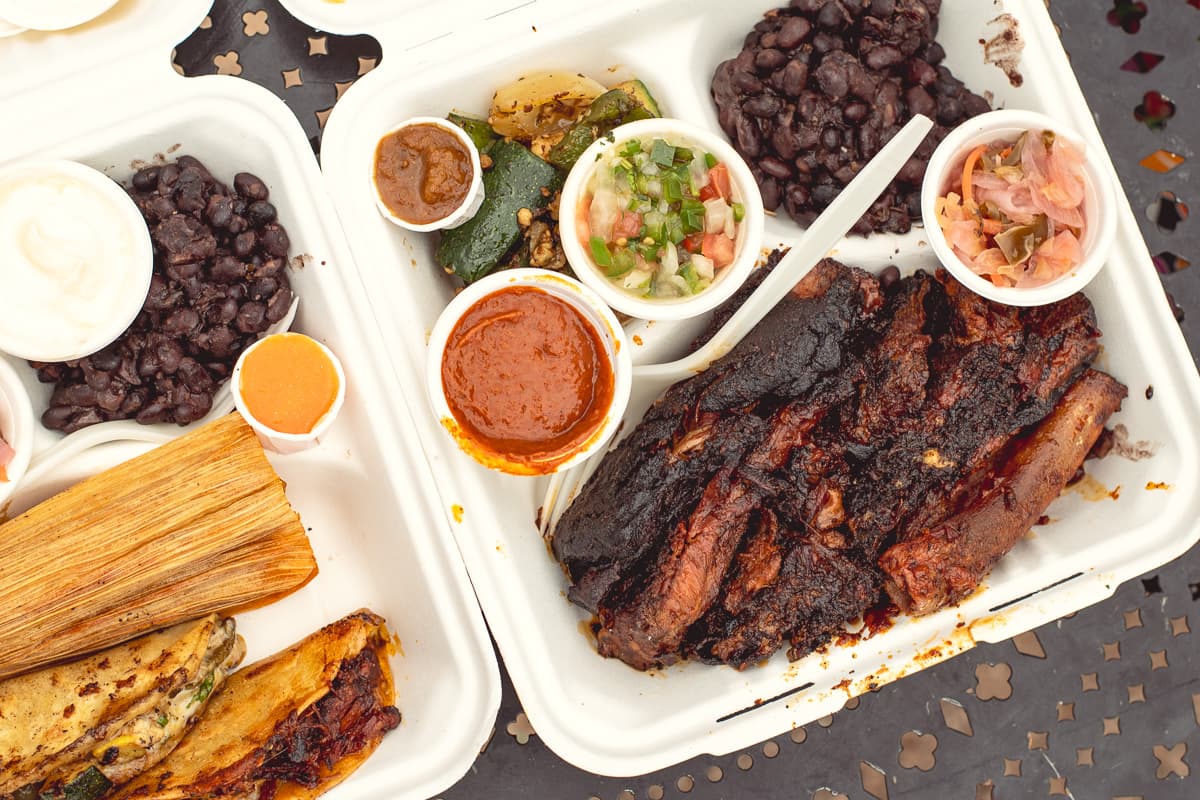
Aware that catering slows down dramatically in summer and as a means to supplement his income, he decided to take the plunge. Using a commissary kitchen for dishes like his Sonoran BBQ ribs, which require full-scale cooking equipment, he set up a taco stand.
Location, location, location
He stationed it on Treat Avenue, just south of Glenn Street, in the quiet residential neighborhood where he lives. Not only was the location convenient for Padilla, but his neighbors were extremely enthusiastic. “The outpouring of support is amazing,” he said.

It was also a smart business decision. The street is part of the designated Treat Avenue Bicycle Boulevard, which means that many potentially hungry cyclists pedal by. It also means that motorists have to slow down to accommodate the cyclists, so an impulsive decision to stop at a taco stand doesn’t require inconveniencing lanes of fast-moving cars.
The next phase of Apacheria Cukson, a food truck, will require more complex parking arrangements.
Padilla already owns the truck and is just waiting to raise the money for the modifications needed to optimize functions and to pass inspection; he’s also planning to get a variance to install a smoker. “I got it at a decent price,” he said, “but life happens, and the world's expensive right now.”

In the meantime, buoyed by immense local interest, he’s manifesting success, thinking ahead to possible locations: “Maybe I’ll try right down the street between the dispensary and a bar, put up a sign that says ‘Firefighters love tacos,’ because there’s a fire station nearby.”
Stay tuned.
Apacheria Cukson is located at 2555 N. Treat Ave. Keep up with Apacheria Cukson on Instagram for operating hours, which may vary.

![How Jun Dynasty built a loyal following in Tucson since 2013 [PHOTOS]](/_next/image?url=https%3A%2F%2Fwgwexrkqokkyffktcsqd.storage.supabase.co%2Fstorage%2Fv1%2Fobject%2Fpublic%2Fmedia%2Fmedia%2Flocations%2Ftf-jun-dynasty-beef-and-tofu-stew-in-flaming-chili-oil-0097-3ab869e30c42.jpg&w=3840&q=75)